
Understanding Moderate Learning Disabilities in Children
How to Identify Them Early and Offer the Right Support at School and at Home

Introduction
Every child’s learning journey is unique. Some breeze through reading, writing, and math, while others may struggle to keep pace. For many children, challenges such as short attention spans, difficulty remembering instructions, or slower reading skills are temporary hurdles they eventually outgrow. But for others, these signs may point to moderate learning disabilities, differences in how their brains process information.
Hearing that a child may have a learning disability can feel unsettling for any parent. Yet, recognizing the signs early is not a verdict of failure; it’s the beginning of finding tailored interventions that allow the child to thrive. With the right understanding, patience, and support, both at home and in school, children with learning difficulties can achieve remarkable growth.
What Are Moderate Learning Disabilities?
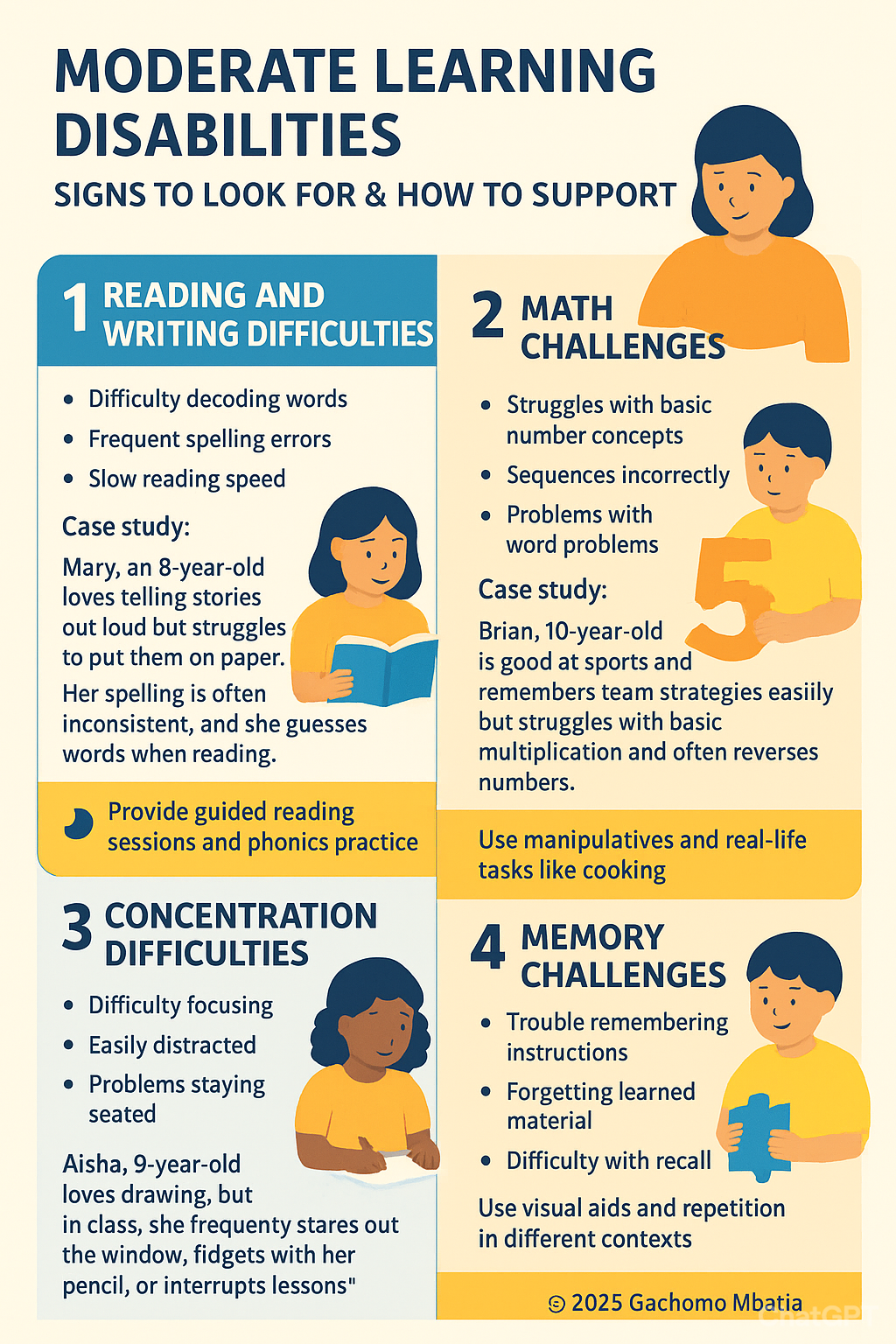
Moderate learning disabilities are challenges that affect a child’s ability to process, understand, or communicate information. They are not immediately obvious - often, these children appear bright, curious, and capable in other areas. Their struggles usually surface in specific skills such as:
Reading and Writing: Difficulty decoding words, frequent spelling errors, or slow reading speed.
Math: Struggles with basic number concepts, sequencing, or problem-solving.
Concentration: Difficulty focusing for extended periods, easily distracted.
Memory: Trouble remembering instructions or retaining what was learned the previous day.
These challenges may not show up until the demands of school increase, making them easy to overlook in the early years.
How to Identify Possible Signs
Parents and teachers should watch for consistent patterns, not isolated incidents. Some red flags include:
A child consistently avoids reading or math tasks.
Difficulty following multi-step instructions.
Writing that is messy, incomplete, or far below age expectations.
Forgetfulness, even after repetition.
Struggles to stay seated or pay attention in class.
Over-dependence on peers for help.
⚠️ Important: These signs do not confirm a learning disability. They are indicators that further observation and possibly professional assessment are needed.
Examples of Moderate Learning Disabilities in Action
1. Reading and Writing Difficulties
Case Study:
Mary, a bright 8-year-old, loves telling stories out loud but struggles to put them on paper. Her spelling is often inconsistent, and she guesses words when reading instead of sounding them out. Her teacher notices she avoids reading aloud in class and prefers group activities where others can do the writing.
What this shows: Mary may have a reading-related learning disability such as dyslexia. With guided reading sessions, phonics practice, and patient encouragement, she can gradually improve.
2. Math Challenges
Case Study:
Brian, 10 years old, is good at sports and remembers team strategies easily. However, when it comes to math, he struggles with basic multiplication and often reverses numbers. When given a word problem, he can’t figure out the steps to solve it. At home, he avoids helping with shopping because he fears “getting it wrong.”
What this shows: Brian could have dyscalculia (a math-related learning difficulty). Practical interventions like using manipulatives, games, or real-life tasks (cooking, measurements, money handling) can build his confidence.
3. Concentration Difficulties
Case Study:
Aisha, 9 years old, is very creative and loves drawing. In class, however, she frequently stares out the window, fidgets with her pencil, or interrupts lessons with unrelated comments. Despite knowing the answers, she rarely finishes her work on time.
What this shows: Aisha may have attention-related challenges such as ADHD. Teachers can help by giving her short, clear instructions and frequent breaks, while parents can create structured routines at home.
4. Memory Challenges
Case Study:
David, 11 years old, understands math during class but forgets the steps by the next day. He constantly asks for instructions to be repeated and struggles to recall spelling words even after practice. Despite studying for a test, he performs poorly because he can’t retrieve the learned information under pressure.
What this shows: David may have a working memory issue. Strategies like visual aids, step-by-step notes, and repetition in different contexts can support him. Parents can also reinforce learning with games and daily practice at home.
How Teachers Can Support in School
Teachers play a critical role in creating an inclusive environment for children with learning challenges. Some practical strategies include:
Differentiated Instruction – Present lessons using multiple approaches (visual aids, practical activities, group discussions).
Break Down Instructions – Give tasks in smaller, manageable steps instead of long, complex directions.
Provide Extra Time – Allow flexibility in tests or assignments to reduce pressure.
Positive Reinforcement – Celebrate effort, not just correct answers, to build confidence.
Collaborate with Specialists – Work with school psychologists, speech therapists, or special needs educators when available.
How Parents Can Support at Home
Parents are partners in addressing learning challenges. Helpful approaches include:
Create a Routine – A structured daily schedule reduces anxiety and builds consistency.
Read Together – Shared reading sessions help strengthen literacy skills while building emotional bonds.
Use Real-Life Math – Cooking, shopping, or budgeting pocket money can make math more practical.
Offer Praise for Effort – Encourage persistence rather than focusing only on results.
Communicate with Teachers – Regular updates ensure interventions are aligned both at school and at home.
💡 Quote for Parents:
“Supporting a child with learning challenges is not about lowering expectations, but about finding the right path for them to shine.” — Gachomo Mbatia
The Bigger Picture
Children with learning disabilities are not less capable; they simply learn differently. With patience, creative strategies, and cooperation between teachers and parents, these children can thrive in academics, social life, and beyond. The earlier the support is given, the more doors are opened for their success.
Disclaimer
This article is based on my professional experience as a teacher and school leader, enriched by observation and research. It does not replace specialist diagnosis. If you suspect your child may have a learning disability, please seek assessment and guidance from qualified professionals.
© 2025 Gachomo Mbatia. All rights reserved.